Work / 001 ACTIVE R&D
Offline Transaction Card
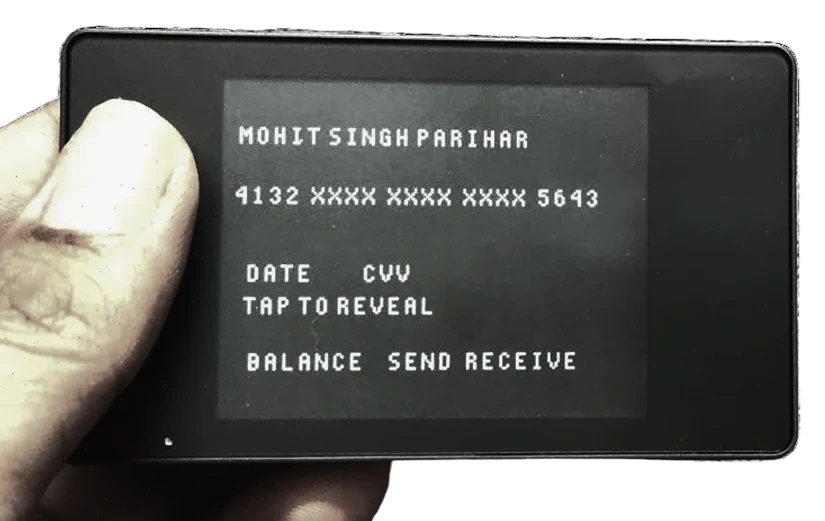
A touchscreen payment card that transacts with the network off, in a true credit-card footprint.
- thickness compression, prototype to target
- network dependency at point of sale
- px · custom display typeface
- post-quantum secured
Sequence · an offline transaction
- A A basement market. No signal for hours. The merchant's terminal is… another Dravya card, flipped to RECEIVE.
- B Tap. Keys exchange card-to-card and the transaction is signed with post-quantum cryptography. No tower, no router, no acquirer in sight.
- C Both cards hold the signed record. It settles whenever either next touches a network. The dead zone never noticed.
01 · Premise
Digital payments stop working the moment the network does. In markets where connectivity is the weakest link (and increasingly, where the line itself is the attack surface), every card transaction still assumes a live connection to a server.
We asked a simpler question: what if the card could do the work itself?
The result is our flagship internal program: a touchscreen credit/debit card that can initiate and record transactions with no real-time network connection, built to stay secure into the era after today’s cryptography stops holding. It is early, it is unannounced, and most of what makes it work stays off this page. What follows is the part we can show.
02 · The display problem
A card that transacts needs to show you things (balance, amount, confirmation), and a card that lives in a wallet for years cannot afford a power-hungry screen.
We built around a bistable electrochromic display: it holds its image with effectively zero power draw, sipping energy only when the pixels change. Driving one inside a card’s mechanical and power envelope meant designing the display stack, the driver, and the interaction model together, as one system.
It also meant designing a typeface. At this resolution, text gets 35 pixels per character, a 7×5 matrix. We engineered a connected-dot font for it: rounded pixels for optical continuity, confusion-risk-mapped across numerals and letters, validated in a 47-participant legibility study, with Devanagari extensibility on the roadmap. It now ships inside the card’s operating system, and it’s the dot-matrix lettering you see on this website.
03 · Miniaturization log
This is the discipline the company is named for. The functional brief never changed; the volume did.
| Rev | Footprint | Notes |
|---|---|---|
| V1 | ~13 cards thick | Full system proven on the bench |
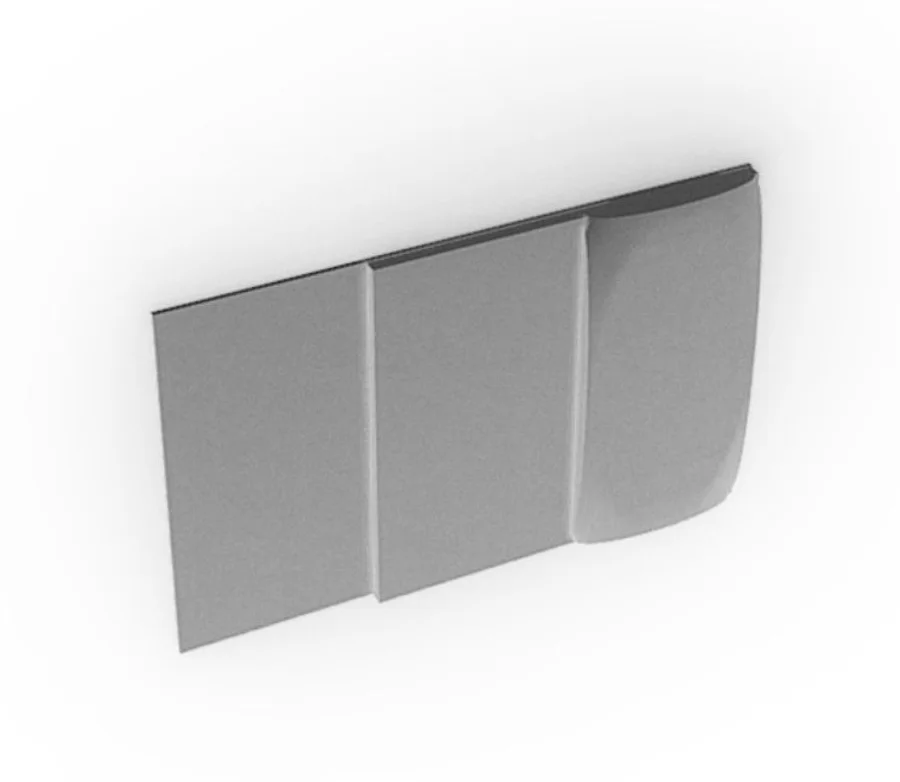
| V2 | 8 / 2 / 1 cards, stepped | Board split and re-stacked; power system redesigned |
| V3 | 1 card | Target: indistinguishable from the card in your wallet today |
04 · Security posture
A card that carries money and keys has to assume it will be attacked, and that the attacker eventually has a quantum computer. So the cryptography is post-quantum, on a dedicated secure element in every card, built for the era when today’s card-security assumptions stop holding.
That is as much as we publish.
[REDACTED] Transaction & key architecture · ████████████████████████████████████
[REDACTED] Offline settlement & reconciliation · ████████████████████████████████
[REDACTED] Capability set & rollout · █████████████████████████████████████████
[REDACTED] Hardware bill of materials · ███████████████████████████████████████
05 · Status
Active R&D, pre-disclosure. Working prototypes run today; the program is driving toward V3 silicon and standard-card mechanicals. Institutions who want to go deeper, under NDA, can start a conversation.