Work / 003 IN PRODUCTION
Trading Terminal
A family office's entire trading desk, rebuilt inside the spreadsheet they already trusted.
- tick-to-screen latency
- minutes · morning workflow, before and after
- automated stop exits, first 3 months, zero errors
- live trading formula functions
Sequence · the unsupervised exit
- A 06:55. The scanner flags a setup: entry, target and stop already computed before the principals finish their coffee.
- B Price runs. The trailing stop ratchets up behind it, tick by tick, up only, never down. Nobody is watching. Nobody needs to.
- C Reversal. The exit executes itself, like 14 others in the first three months, every one correct, none supervised.
01 · Problem
Two principals and an analyst, running concentrated positions on NSE/BSE across broker terminals, Telegram feeds, and hand-maintained spreadsheets. The tooling couldn’t keep pace with the decisions, and the team had no appetite for learning a new platform.
So we didn’t give them one. We rebuilt the desk inside the spreadsheet interface they already used, and put a real-time system underneath it.
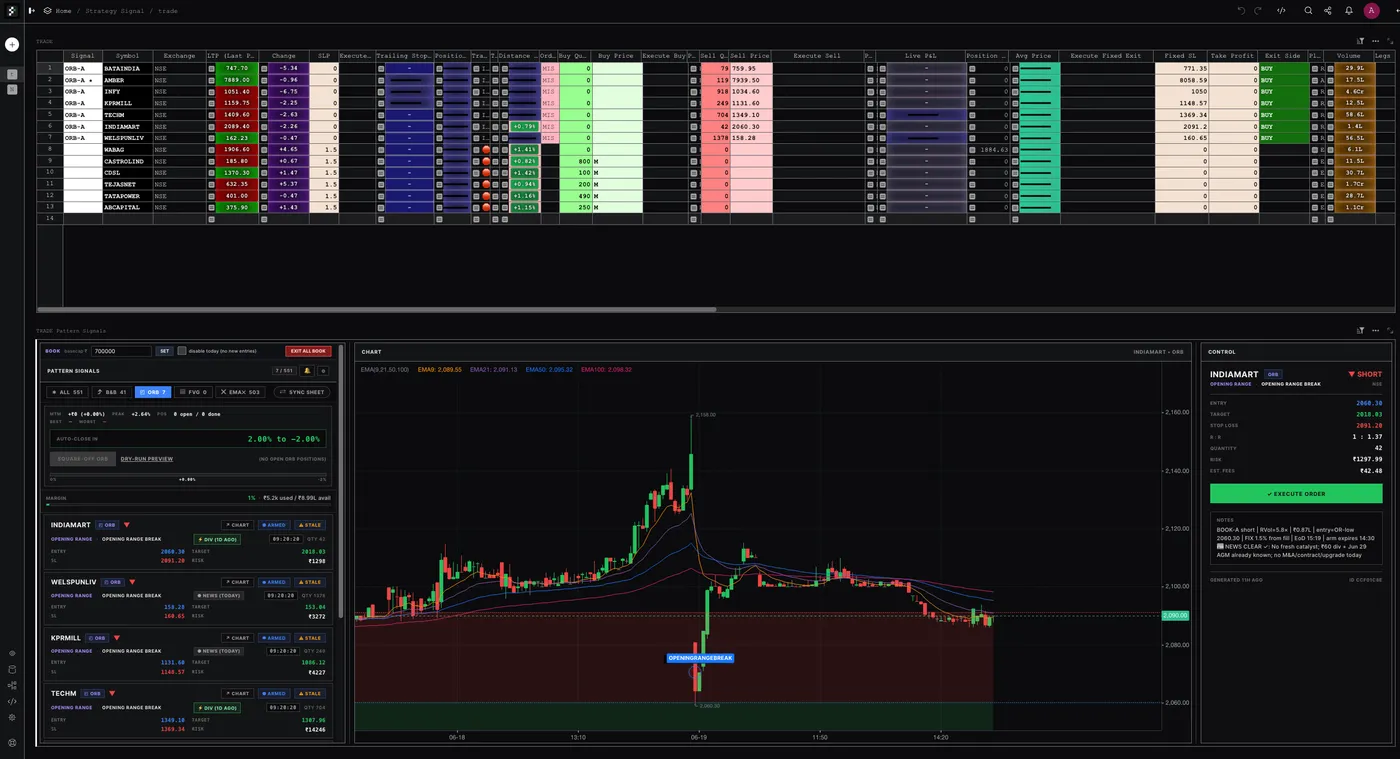
02 · System
Scanning. A picks engine re-scores NSE/BSE listings tick by tick across three timeframes (intraday, swing, positional), grading each on volume, trend, RSI, breakout distance, and moving-average signal as the prices move, and surfaces candidates with entry, target, and stop pre-computed.
Corporate-action intelligence. Exchange RSS feeds run through a 30-billion-parameter model hosted entirely on-premise: announcements classified bullish/bearish with confidence scores and an investment angle. Nothing about the portfolio ever leaves the building.
Edge finder. For intraday, the system looks for repeatable market inefficiencies and puts each candidate through a hard test before trusting it: backtesting against ten years of minute bars and two years of tick-by-tick data. An edge has to hold up across that history to earn a place on the desk.
Execution guard. When a qualifying setup fires, the engine arms the order on its own, and arms it with the stop-loss type that did best in backtest, not a default. From there a trailing stop rides the position and exits when it breaks. In its first three months it took 14 automated exits, every one correct, none supervised.
True cost. A transparency layer itemizes all seven statutory charges hiding behind “zero brokerage”: STT, exchange fees, SEBI charges, GST, stamp duty, DP fees. Seeing real costs cut marginal trade frequency by 20%.
03 · The hard part
Spreadsheets recalculate; markets don’t wait. The core engineering was a WebSocket overlay that streams live data onto the sheet sub-100ms without triggering document recalculation or disk writes: the spreadsheet stays a spreadsheet, while behaving like a terminal. On top of it: 40+ hot formula functions (live prices, RSI, trailing stops) backed by Redis TimeSeries pub/sub, the whole stack containerized on the client’s own hardware.
04 · On-prem, and onto hardware
The whole system runs on the family office’s own machines. The 30-billion-parameter model that reads corporate-action filings sits on a GPU box in their office instead of a cloud API, so the portfolio and the trades it’s about to place never leave the premises. For this client that came first, and the rest of the system was built to fit around it.
We’re now taking parts of the desk down to dedicated hardware:
- Kernel-bypass feed handler. The market data and order path are moving off the normal OS network stack onto a kernel-bypass NIC running on its own CPU core, which keeps feed latency steady and predictable. It gets us most of the determinism people reach for an FPGA to find, with a lot less work.
- GPS-disciplined timing. A GPS clock stamps every tick and order against real time rather than the server’s clock, so we can line our own latency up against the exchange’s timestamps and trust what we’re reading.
- On-desk arming console. Orders may arm themselves on their parameters, but none of it reaches the market unless the desk is physically armed. A small box on the principal’s desk shows live P&L and the engine’s state, runs automated trading only while a key is turned, and closes every open position from one covered button. Its display borrows the same 7×5 dot font we drew for the card.
- Secure-element key. A hardware key has to be in the slot before the system will send a live order. Pull it and the engine keeps watching and flagging trades. It just can’t place them.
05 · Outcome
The morning routine fell from 35 minutes of scan-copy-check to 5 minutes of review. The system has been in daily production use through two market years: scanning, classifying, and executing against a live brokerage account.
Same four moves we build into our hardware: sense, decide, act, audit. This system started in software; now it’s growing the hardware to match.