Work / 005 IN BETA
Core Compute Cylinder
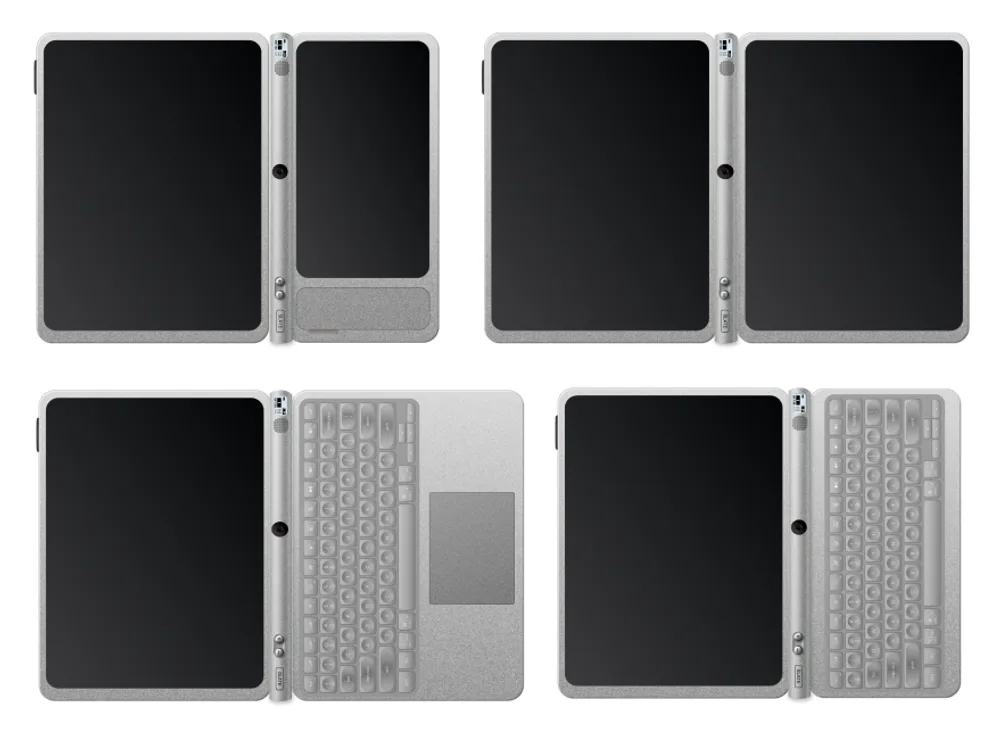
One cylindrical computer. Snap on a screen and it's a tablet; add a keyboard and it's a laptop; fold two panels and it's a book.
- compute core, every device
- form factors from one core
- display technologies, hot-swapped
- modules detected, drivers self-load
01 · Premise
Personal computing fragmented into one device per job: a tablet to read, a laptop to write, an e-reader for the long-form, a second screen for everything else. Each one carries its own processor, its own battery, its own copy of you. The compute is the same; we just keep buying new enclosures for it.
So we inverted the unit. What if the computer were a single core, and every “device” were just a shell you snap onto it?
02 · The core
The Core Compute Cylinder (CCC) is a complete computer in a cylinder: processor, memory, wireless, and power, self-contained. On its own it does nothing you can look at. The moment a module mates to it, it becomes something: the cylinder is the spine, the module is the body.
03 · Many forms
The same core hot-swaps across fundamentally different module types, and across display technologies that normally never share a driver stack: OLED, LCD, RLCD, e-ink, electrowetting, plus input modules like keyboards and second panels.
- Tablet: core + a single display panel.
- Laptop: core hinges a display to a keyboard module.
- Dual-screen: two panels fold like a book; content stays in sync. An e-ink page can launch related dynamic content on the companion LCD/OLED: quiet reading on one surface, live detail on the other.
- E-reader: pair the core with a low-power reflective panel and it disappears into a book.
04 · The intelligent interface
Swapping a screen should be as thoughtless as plugging in headphones. Each module carries its own identity; the core reads it, recognizes the module type, resolution and power profile, and configures itself, loading the right drivers and routing power and data accordingly, including sharing power both ways with accessory modules.
That much is the idea. The how is the hard part, and the part we keep:
[REDACTED] Flat-to-cylinder coupling & latching · █████████████████████████████████
[REDACTED] Universal connector & data/power routing · ████████████████████████
[REDACTED] Module identity & auto-configuration scheme · ███████████████████████
05 · Status
In beta. Working hardware transforms across forms today, core to tablet to laptop to book, and the program is in beta testing toward a manufacturable coupling and the tolerances a consumer device has to survive. We’re showing the vision here, not the mechanism. Builders and partners interested in the platform can start a conversation.